Workshop Update
Why we teach for the decade, not the day
There is a question every parent quietly askes every now and then, is any of this adding up? The lessons, the classes, the Saturday mornings. A child brings home a painting, and it goes on the wall, and somewhere underneath the pride sits the question nobody says out loud. Did that day matter?
Here is our honest answer: nobody can tell you which day will matter. Not us, not any school, not any programme. A child's education is made of thousands of small days, and which one turns out to be the hinge, the day a hand steadied or an idea landed, is something we only ever learn afterwards, if at all. Learning, like childhood, is a marathon and not a sprint. Anyone who promises you otherwise is selling the sprint.
In 1960, the Harvard psychologist Jerome Bruner published a small book called The Process of Education. It has since been translated into some twenty languages, and one sentence from page 33 became among the most quoted in modern education: "Any subject can be taught effectively in some intellectually honest form to any child at any stage of development."
It is a bold claim, and a deeply respectful one. It says children are not waiting rooms for future learners. They are learners now, capable of real ideas at five, at eight, at twelve, provided we do the work of teaching honestly at their level. Bruner also gave education the spiral curriculum: the principle that important ideas should return again and again across a child's years, each time a little deeper, each time building on the last.
If you have spent time with our courses, this will sound familiar. It is how we build everything.

We design our courses, train our tutors, and run this studio with research as our foundation. We lean into learning science, building on what generations of educators and researchers have tested, refined, and proven.
In practice, that means our five year olds and our fifteen year olds are treated the same way: as people capable of real ideas. They learn the words artists and designers actually use. They make real decisions and practice with them. Their work is framed because it deserves framing. And the ideas that matter come back, term after term, wearing new disguises, exactly as the spiral curriculum says they should.
In practice, that means our five year olds and our fifteen year olds are treated the same way: as people capable of real ideas. They learn the words artists and designers actually use. They make real decisions and practice with them. Their work is framed because it deserves framing. And the ideas that matter come back, term after term, wearing new disguises, exactly as the spiral curriculum says they should.
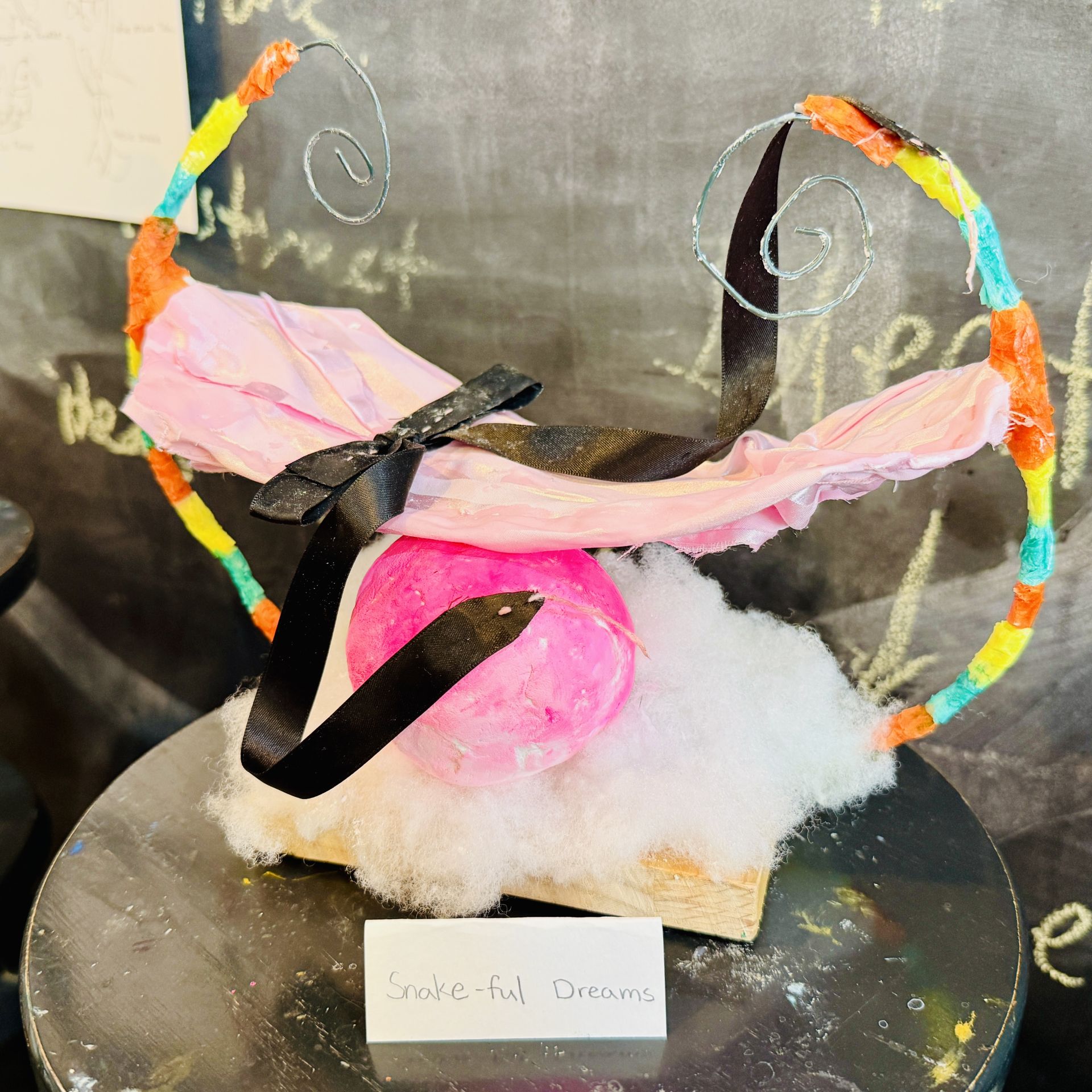
Then time does what time does. On our studio walls, you can trace it: the doodles of a five year old, and a few metres away, the work of students who grew up here, now winning awards for paintings entirely their own. Nobody can point to the single day that made the difference, because there wasn't one. There were hundreds.
What we care about goes beyond the pieces. It is the young people who make them, and we walk alongside them for the long haul, with enormous respect.
The long view is not a slower way to the same place. It is the only way to this place. We are glad to be walking it with your family.
Featured Workshop
Write your awesome label here.
Sign up to our mailing list today!
Thank you!
-
one-click unsubscribe
-
tips, deals and offers
Copyright © AJ Studio, New Zealand 2012-2021